
From Research to Practice: Exploring Digital Twins for Sustainable Infrastructure
21-October-2026
Over the past year, the Institute for Sustainable Infrastructure (ISI) has explored an increasingly important question: How can digital twins help infrastructure practitioners advance sustainability across the project lifecycle?
The effort began with research through ISI’s Zofnass Research Program and grew into a broader initiative spanning research, publications, practitioner education, and knowledge sharing. The result is a collection of resources designed to help infrastructure professionals better understand digital twins and their potential to support more sustainable infrastructure.
The initiative was led by ISI Research Manager Judith Rodriguez and Director of Research and Engagement Jennifer Ninete.
 Building the Foundation
The initiative began with research conducted through ISI’s Zofnass Research Program to better understand the emerging role of digital twins in infrastructure and their connections to sustainability. The research team reviewed literature on digital twins for infrastructure, identifying seven core use cases that appeared consistently across the research. Those use cases were then mapped to credit criteria within the Envision framework to explore connections between digital twin applications and sustainable infrastructure outcomes.
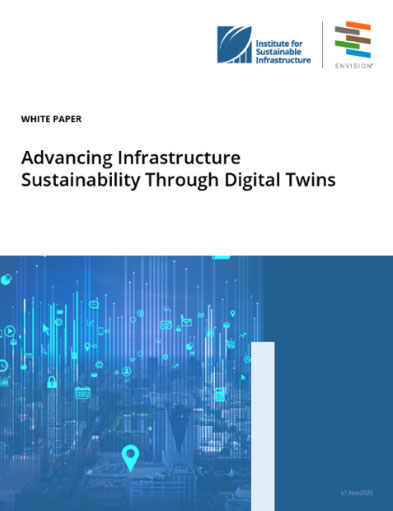
The research became the foundation for Advancing Infrastructure Sustainability Through Digital Twins, a white paper published in November 2025. The paper translates the research for an infrastructure practitioner audience, highlighting sustainability benefits associated with digital twins and featuring case studies that demonstrate how the technology is being applied on infrastructure projects.
Bringing the Conversation to Practitioners
Building on the research and white paper, ISI launched a five-part webinar series in 2026 to explore the topic through practical insights, real-world case studies, and expert perspectives.
Each webinar was presented live. The series began with foundational discussions about digital twins, their applications, and their connections to Envision before moving into case studies focused on climate resilience and coastal protection; mobility, asset performance, and city-scale digital governance; and decarbonization, resource efficiency, and urban-scale twins.
Webinars
Overview: Digital Twins as a Catalyst for Sustainable Infrastructure
Driving sustainable infrastructure with digital technologies and the Envision Framework
Case Study Deep Dive #1: Climate Resilience & Coastal Protection
Case Study Deep Dive #2: Mobility, Asset Performance & City-Scale Digital Governance
Case Study Deep Dive #3: Decarbonization, Resource Efficiency & Urban-Scale Twins
ISI extends its thanks to the guest speakers who shared their expertise and perspectives throughout the series: Edita Kemzuraite, Bentley Systems; Rodrigo Fernandes, Bentley Systems; Roni Deitz, Arcadis; Dean Tarulli, NYC DDC; and Dr. Rajeev Ruparathna, Associate Professor in Civil & Environmental Engineering at the University of Windsor. Their contributions helped connect the research to real-world infrastructure practice and brought additional perspectives to the conversation.
The live webinars attracted strong participation. Following the live events, the recordings were added to ISI’s educational platform, where each of the five sessions is available for on-demand learning. The recorded content has continued to attract learners and receive positive ratings.
The webinar series expanded on the initial research through discussion and real-world applications. ISI also developed a separate, focused learning experience that brings the foundational concepts explored through the initiative together in a structured format.
A Focused Course: Digital Twins for Sustainable Infrastructure
Launched in July 2026, ISI’s Digital Twins for Sustainable Infrastructure course is a two-hour, asynchronous learning experience that examines the role of digital twins in sustainable infrastructure across the full project lifecycle.
Participants explore major digital twin use cases, and consider how applications can improve performance, reduce risk, and strengthen sustainability outcomes. The course also examines connections between digital twin applications, lifecycle thinking, and the Envision framework.
Through the course, learners will:
- Explain why digital twins matter in sustainable infrastructure practice.
- Define what a digital twin is, including the difference between a twin and its supporting software ecosystem.
- Describe major digital twin use cases and the kinds of problems each is designed to solve.
- Analyze how digital twins support sustainability outcomes aligned with lifecycle thinking and the Envision framework.
- Identify future opportunities and challenges for scaling digital twins in sustainable infrastructure practice.
Since its launch, the course has attracted strong participation and positive learner feedback, reflecting continued interest in the relationship between digital technologies and sustainable infrastructure practice.
The course is available to anyone interested in exploring the topic, with no ISI account or login required.
Continuing the Conversation
Digital twins remain an evolving area of infrastructure practice. This initiative was designed not simply to explore the technology itself, but to help practitioners consider where and how digital twins can contribute to more sustainable infrastructure outcomes.
What began as a research question through ISI’s Zofnass Research Program has grown into a white paper, a five-part webinar series available for on-demand learning, and a focused two-hour course that provides an additional way to explore digital twins and their application to sustainable infrastructure.
The conversation will continue at ASCE2027 with the presentation From Data to Decisions: Aligning Digital Twins with the Envision Framework. Drawing on insights from the white paper, the presentation will explore how digital twin use cases align with Envision credits and can support more transparent, defensible decision-making. It will also use case studies and practical guidance to examine considerations for incorporating digital twins into Envision-aligned projects, including early adoption, governance, data integration, and workforce capabilities.
Together, these resources provide multiple ways for infrastructure professionals to engage with the topic, whether exploring the underlying research, learning from expert perspectives and real-world applications, or building foundational knowledge through the focused course.
Ready to learn more? Explore ISI’s digital twins resources and discover how digital technologies can support more sustainable infrastructure.