

Two Years Post AIRO Guide: How the Aviation Industry is Using Envision Today
8-February-2026
By ISI Guest Author: Courtney Gantt
With expanded support from ISI and Airports’ out-of-the-box thinking, aviation’s engagement with Envision has doubled over the past eight years and infrastructure development is becoming ever-more sustainable. In this blog, you will learn how aviation infrastructure sustainability and resilience is on the rise with Envision, underscored by examples from airports across the country.
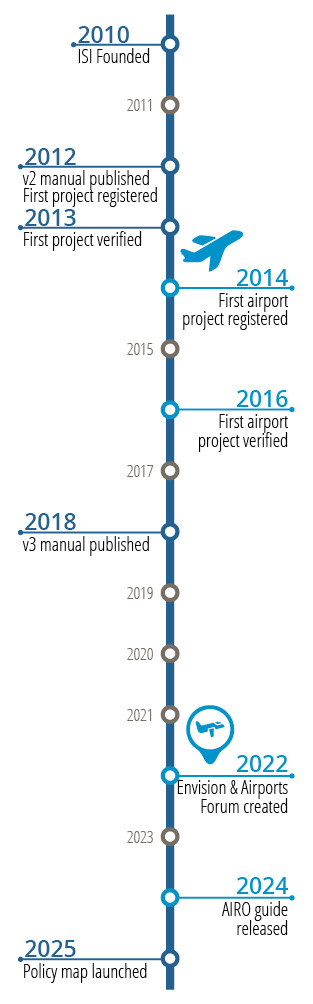
The evolution of airports and Envision in relation to ISI Envision framework development
Airports and Envision: The Evolution
At the beginning, verifying airport projects was hard. Airports are complex places — they are like small cities — with strict regulations and strong safety standards. Many airfield development projects are overseen by the Federal Aviation Administration (FAA) which maintains stringent design standards for pavement sections, wildlife management, and stormwater control. Stakeholder engagement was often limited. It could be difficult to engage the community outside of a regulatory required process, and there were seemingly limited options for creativity, such as enhancing views and local character, because of budget constraints and strict FAA and Transportation Security Administration (TSA) regulations. Many airport projects struggled with credits such as NW 1.4 Preserve Undeveloped Land because infield areas with grass were considered “undeveloped,” or NW 1.3 Preserve Prime Farmland because despite being on airport property, the soils were classified as farmland soils according to the US Geological Survey.
It was at this point that ISI and industry leaders recognized that airports needed more support, guidance, and tailored resources to reach their potential for sustainable development. In 2022, in partnership with industry consultants, ISI formed the Envision and Airports Forum (formerly Envision and Airports Working Group) to bring airport practitioners together to discuss challenges and bring solutions for how to use Envision at airports. Then, in 2024, ISI released the Envision Airports: Insights, Resources, and Opportunities Guide otherwise known as AIRO Guide Most recently, ISI released the Envision Policy Map. This repository shows the many ways that Envision can be implemented in a programmatic way at airports (e.g., Austin-Bergstrom International Airport and Denver International Airport) and provides examples for other airports to implement similar types of guidelines and capital project requirements. According to ISI, by the end of 2025, there were 69 registered airport Envision projects (28 of which are verified). This number represents an impressive increase of 56 projects in the verification program since 2018, doubling airports’ share of total projects (registered, under review, and complete) from 7% to 13%.
But these numbers only tell half the story. While ISI focused on developing new resources, airports have started to “think outside the box” to increase sustainable and resilient development on their capital projects.
Thinking Outside the Box
There are five ways airports are thinking outside of the box to advance sustainable infrastructure. These include: thinking outside the fence, thinking beyond the airfield, thinking like a contractor, thinking about resilience, and thinking of the future.
1. Thinking Outside the Fence
If you consider your Envision project boundary as a box, you may have to think outside of it to succeed at an airport. For credits like QL 3.3 Enhance Views and Local Character and QL 3.4 Enhance Public Spaces and Amenities, this means looking across the security fence. Inside, safety and security requirements enforced by FAA and TSA can be inflexible. Outside, opportunities like improving the Airplane Viewing Area — where kids will look at planes taking off from your new runway — or adding decorative screening to fences or temporary barriers can improve the public’s experience.
The art feature “Transitions” at the Indianapolis International Airport, developed as a part of the Platinum-verified Runway 5R-23L Strengthening and Capacity Expansion Project. Photo Attributed to Kelly Lynn Photography, LLC via Indianapolis Airport Authority.
2. Thinking Beyond the Airfield
Major airfield projects, which expand capacity and are often FAA-funded, are obvious candidates for Envision verification. Outside this area are landside projects, which can also be great opportunities for sustainable infrastructure. Many airports are currently utilizing the Envision framework for parking lots, solar power, roadways, and rental car and maintenance facilities. These projects may lend themselves better to creative design and innovation since they are public facing, so community perception may be more important. For example, airports can explore alternative stormwater control measures and native plantings, use pavement materials with higher percentages of recycled asphalt or crushed concrete, and add art installations or educational features.
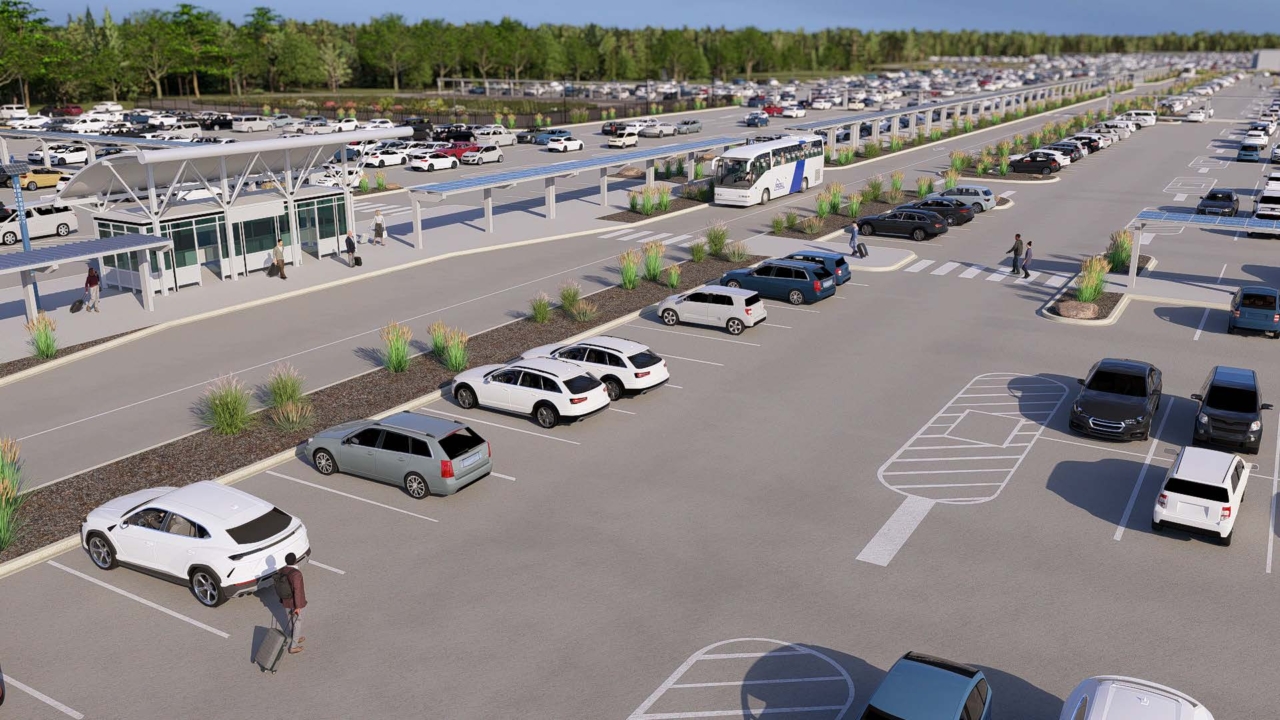
Rendering of the new Park Economy 3 Project at Raleigh-Durham International Airport, which was recently verified at the Envision Platinum level. Rendering by RS&H, Inc.
3. Thinking Like a Contractor
Project teams often focus on design, under the assumption that contractors are not as open to sustainability measures. Outside of the design box, contractors are motivated to optimize construction budgets by finding ways to improve efficiency, whether by reusing materials on-site, finding shorter haul routes, or using available non-potable water sources. Thinking like a contractor might mean looking at your project site and determining if temporary stormwater basin water could be pumped and used for dust control or whether there may be a closer airfield access gate to reduce hauling. Implementing a sustainability specification and requiring a contractor to choose from a set of options to reduce construction water or energy use can also provide flexibility for contractors to track and demonstrate resource optimization and efficiency. In addition, teams can consider how they can engage contractors during design (e.g., in Construction Manager at Risk or Design-Build projects) or even hosting meetings during pre-construction or within the first month on site to understand options for tracking fuel use, sourcing water, or stockpiling materials. These conversations often open new opportunities for sustainable construction and support Envision credits like RA 2.2 Reduce Construction Energy Consumption and RA 3.3 Reduce Construction Water Consumption.
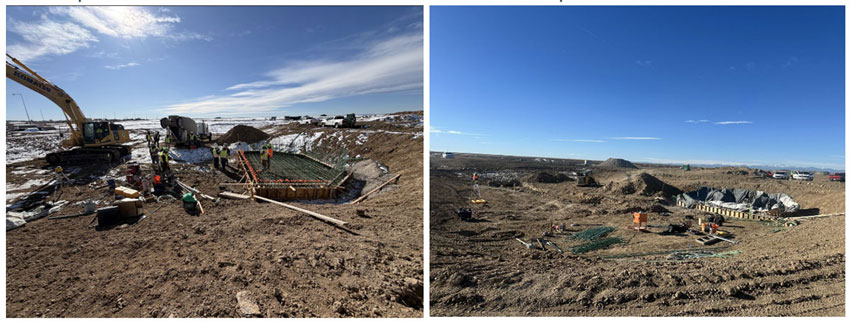
The Denver International Airport’s South Worldport Parking Lot Project, currently in verification, is stockpiling soils to reuse on site and is utilizing a local batch plant to reduce fuel and emissions from hauling. Photos attributed to RS&H, Inc.
4. Thinking About Resilience
Envision is more than just a framework for sustainable infrastructure. Outside of this box is resilience — increasing an airport’s capacity to weather future impacts. Airports have long focused on risk management to increase efficiency and safety, protect critical assets and maintain operations. Envision encourages organizations to add climate threats to the mix. Many airports are embarking on airport-wide climate and vulnerability assessments. These can be leveraged for Envision projects, e.g., the credit series including CR 2.2 Assess Climate Change Vulnerability through CR 2.5 Maximize Resilience credit. These credits help airports consider whether upsizing drainage systems, implementing microgrids to decrease dependence on electrical grids, or increasing wind load for critical structures would make sense for a project.

Rendering of the new 4th parallel runway at Charlotte-Douglas International Airport (currently in verification), where stormwater drainage design was upsized beyond the FAA requirements, sizing systems for the 10-year storm event. Rendering by RS&H, Inc.
5. Thinking of the Future
The final box to think beyond? The present. Most of the time, projects teams focus on executing from planning through design and construction, to project close-out. However, Envision asks teams to think about what will come after. What systems, processes, and procedures are in place to ensure the project is performing sustainably? For credits like LD 2.3 Plan for Long-Term Monitoring and Maintenance or NW 2.3 Reduce Pesticide and Fertilizer Impacts, project teams may need to work with operations and maintenance personnel to understand how the project will function after it’s constructed. If the airport has a Pavement Management Plan, consider which areas are included under this plan (i.e., is it only airfield areas or are large landside parking lots and roadways included?) and the frequency for monitoring pavement condition. Teams should also ask whether the airport has policies governing the use of pesticides and fertilizers. Some airports have permits to manage invasive species populations, including the use of pesticides, so project teams should be aware of these considerations and how they might apply to related credits like NW 3.4 Control Invasive Species. Further, airports can consider developing operations and maintenance documents with sustainability in mind (e.g., building in training requirements and schedules for responsible personnel), which supports future Envision projects and improved performance.
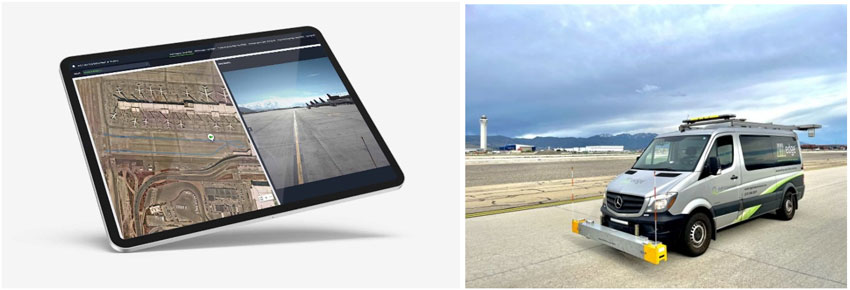
Salt Lake City International Airport utilizes an advanced pavement performance and inspection system to inform long-term monitoring and maintenance. This technology will be applied on the new Taxiways Uniform and Victor Project, which is currently going through verification. Photos attributed to SLC Airport and Applied Pavement Technology.
What’s Next?
Envision verified aviation projects span $20-million to $1-billion initiatives, airside and landside projects, and small GA airports and large hubs. But there is always room to grow. Airports on the forefront of Envision adoption are now looking to:
▶ Develop sustainable infrastructure programs encompassing all capital development as opposed to standalone Envision projects
▶ Create sustainable and resilient design and construction standards, often incorporating Envision principles
▶ Produce airport-specific Envision guidance documents for project teams with standardized coversheets
▶ Develop websites to track and report on Envision projects including construction progress; construction waste, energy, and water reductions; and community engagement and workforce development
▶ Utilize Envision verified projects to secure funding (e.g., green bonds)
If you’d like to learn more about Envision implementation at airports, feel free to fill out the new Get Involved page on the ISI website. The next Airports and Envision Forum is February 26, 2026 from 1:30-3:00 pm ET, and we welcome new members to be involved!

Author Bio:
Courtney Gantt is a Sustainability and Resilience Consultant at RS&H. She serves as the firm’s Envision leader with experience leading sustainable design and construction efforts on a wide range of aviation and transportation projects including runways and taxiways, roadways, parking lots, and energy generation projects. Most recently, Courtney led the Raleigh-Durham International Airport (RDU)’s first verified project, the Park Economy 3 Expansion Platinum Project. With multiple years of experience in energy, environmental, and sustainability roles, she provides insight into the synergies between environmental compliance and sustainability initiatives. Courtney also serves as the co-chair of the Envision and Airports Forum and is passionate about expanding Envision implementation in the aviation sector. Connect with her on LinkedIn.
Photo attributions: Kelly Lynn Photography, LLC via Indianapolis Airport Authority; RS&H, Inc.; SLC Airport and Applied Pavement Technology.